
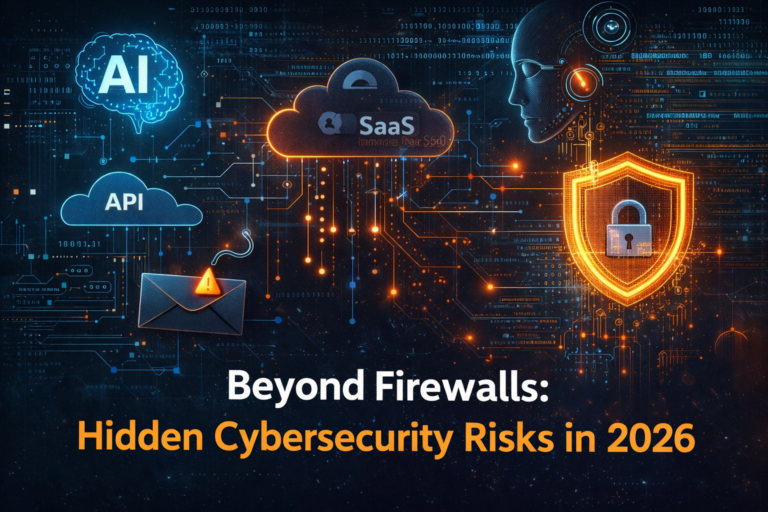
Cybersecurity conversations usually start the same way: ransomware, phishing, malware, data breaches. Important topics? Absolutely. But if that’s all you’re focusing on in 2026, you’re defending yesterday’s battlefield.
Today’s cyber threats are quieter. They don’t always crash systems or encrypt files. Instead, they manipulate APIs, poison AI systems, exploit SaaS sprawl, and harvest metadata. They blend in. They look legitimate. And that’s what makes them dangerous.
If your business relies on cloud computing, automation, artificial intelligence, remote teams, or third-party integrations — this article will open your eyes to the cybersecurity blind spots you probably haven’t considered.
Let’s go deeper than the usual headlines.
1. API Security: The Most Exploited Attack Surface in Modern Applications
APIs power everything. Your mobile apps, payment systems, CRMs, AI tools, and cloud services all talk to each other through APIs. They are the connective tissue of digital infrastructure.
And attackers love them.
Unlike traditional network breaches, API attacks often look like normal traffic. Hackers don’t “break in” — they simply abuse poorly configured endpoints.
Common API Security Vulnerabilities
Broken authentication
Excessive data exposure
Lack of rate limiting
Improper access controls
Insecure direct object references (IDOR)
Here’s the problem: many companies focus on frontend security but ignore backend API monitoring.
API Attack Impact Table
| Vulnerability Type | Potential Damage | Detection Difficulty |
|---|---|---|
| Broken Authentication | Account takeover | Medium |
| Excessive Data Exposure | Mass data leaks | High |
| No Rate Limiting | Data scraping | Low |
| Insecure Endpoints | Privilege escalation | High |
How to Strengthen API Security
Implement API gateways with strict authentication
Use OAuth 2.0 and token-based access
Enable rate limiting and throttling
Monitor unusual API call patterns
Conduct regular API penetration testing
APIs are no longer just technical components. They are front doors.
2. AI-Powered Cyber Attacks: Automation at Criminal Scale
Artificial intelligence isn’t just helping businesses — it’s helping cybercriminals too.
Attackers now use AI to:
Generate highly convincing phishing emails
Clone executive voices (deepfake attacks)
Automate vulnerability scanning
Adapt malware behavior dynamically
Imagine receiving a voice message that sounds exactly like your CFO requesting an urgent payment. That’s not science fiction anymore.
AI vs Traditional Cyber Attacks
| Traditional Attack | AI-Powered Attack |
|---|---|
| Generic phishing emails | Personalized AI-written phishing |
| Static malware code | Adaptive self-modifying malware |
| Manual reconnaissance | Automated vulnerability mapping |
| Script-based fraud | Deepfake-driven social engineering |
The scale is what makes it terrifying. AI allows attackers to target thousands of victims simultaneously — with personalization.
Defense Strategy
Deploy AI-driven threat detection
Use behavioral analytics systems
Train executives on deepfake awareness
Implement strict multi-step transaction verification
In this new era, cybersecurity must fight AI with AI.
3. Shadow SaaS and SaaS Sprawl: The Invisible Security Gap
How many SaaS tools does your company use?
If you guessed 20, you’re probably wrong. Most mid-sized companies use 100+ SaaS applications. And many of them are not approved by IT.
This phenomenon is called Shadow SaaS — employees signing up for tools without security oversight.
Marketing signs up for analytics software. HR adopts an AI résumé scanner. Sales integrates a third-party CRM plugin.
Each one stores data. Each one has login credentials. Each one creates risk.
Why Shadow SaaS Is Dangerous
Weak password hygiene
No centralized access control
Unknown data storage regions
Limited encryption transparency
Poor vendor security standards
Shadow SaaS Risk Breakdown
| Risk Area | Consequence |
|---|---|
| Weak Authentication | Account compromise |
| Poor Vendor Security | Third-party breach exposure |
| No SSO Integration | Credential sprawl |
| Lack of Monitoring | Undetected data leaks |
Prevention Measures
Use SaaS discovery tools
Enforce Single Sign-On (SSO)
Deploy Cloud Access Security Brokers (CASB)
Conduct quarterly SaaS audits
You can’t defend assets you don’t know exist.
4. AI Model Poisoning: A Silent and Sophisticated Threat

Businesses are deploying AI models for fraud detection, recommendation engines, chatbots, cybersecurity monitoring, and predictive analytics.
But here’s something few companies consider:
What if the AI itself is compromised?
AI model poisoning occurs when attackers manipulate training data so the model behaves incorrectly.
Instead of hacking your firewall, they corrupt your intelligence layer.
Real-World Risk Examples
Fraud detection systems misclassifying malicious transactions
Content moderation tools allowing harmful content
Recommendation systems promoting malicious links
Security AI failing to detect anomalies
AI Security Checklist
Validate all training datasets
Segment AI training environments
Monitor model output anomalies
Restrict access to AI pipelines
Use adversarial testing techniques
AI isn’t magic. It’s code and data. And both can be attacked.
5. Metadata Exploitation: The Data You Didn’t Know Was Valuable
Even if your core data is encrypted, attackers may still extract insights from metadata.
Metadata includes:
Login timestamps
IP addresses
Device fingerprints
Access frequency patterns
User behavior metrics
This is known as data exhaust exploitation.
Hackers can map infrastructure and identify high-value targets just by studying patterns.
Metadata Risk Comparison
| Data Type | Encrypted? | Still Exploitable? |
|---|---|---|
| User Passwords | Yes | No |
| Login Timestamps | Sometimes | Yes |
| IP Logs | Rarely | Yes |
| Device Identifiers | Often No | Yes |
How to Protect Metadata
Encrypt logs
Anonymize IP addresses
Limit external log access
Monitor unusual log scraping behavior
Cybersecurity isn’t just about protecting content — it’s about protecting context.
6. Zero Trust Architecture: The Only Sustainable Model
Traditional security models assumed internal networks were safe. That assumption is dead.
Zero Trust operates on one principle:
Never trust. Always verify.
Every access request must be authenticated — regardless of location.
Core Components of Zero Trust
Multi-factor authentication (MFA)
Least privilege access control
Continuous device verification
Micro-segmentation of networks
Real-time monitoring
Traditional vs Zero Trust Security
| Traditional Model | Zero Trust Model |
|---|---|
| Trust internal users | Verify every request |
| Perimeter-based defense | Identity-based defense |
| Static access control | Dynamic contextual access |
| Limited monitoring | Continuous monitoring |
In a remote, cloud-driven world, Zero Trust is not optional — it’s foundational.
7. Securing the Modern Remote Workforce
Remote work is permanent. Employees access corporate systems from home networks, cafes, airports, and shared spaces.
Each device becomes a potential entry point.
Remote Security Risks
Unsecured Wi-Fi networks
Outdated personal devices
Shared family computers
Lack of endpoint protection
Best Practices for Remote Security
Deploy Endpoint Detection and Response (EDR) tools
Enforce device compliance checks
Use VPN with strong encryption
Require MFA for all logins
Conduct continuous employee training
People are often the weakest link — but they can also be the strongest defense.
Conclusion
Cybersecurity in 2026 is no longer just about blocking malware or preventing ransomware. The real threats are:
API exploitation
AI-driven attacks
Shadow SaaS sprawl
AI model poisoning
Metadata intelligence harvesting
Deepfake social engineering
Businesses that focus only on traditional threats are defending the past.
Modern cybersecurity must be:
Adaptive
AI-powered
Identity-centric
Data-aware
Proactive
The companies that win the digital future won’t just innovate faster. They’ll secure smarter.
FAQs
1. What is the biggest emerging cybersecurity threat in 2026?
API exploitation and AI-powered cyber attacks are among the fastest-growing and hardest-to-detect threats.
2. Why is Shadow SaaS dangerous?
It creates unmonitored access points where sensitive data may be stored without proper security controls.
3. How does AI help in cybersecurity defense?
AI analyzes behavioral patterns, detects anomalies in real time, and automates threat response.
4. What is Zero Trust security?
Zero Trust is a security model that requires continuous authentication and verification for every user and device.
5. How can businesses prepare for AI-driven attacks?
By deploying AI-based defense systems, strengthening authentication processes, and training staff about deepfake and advanced phishing threats.