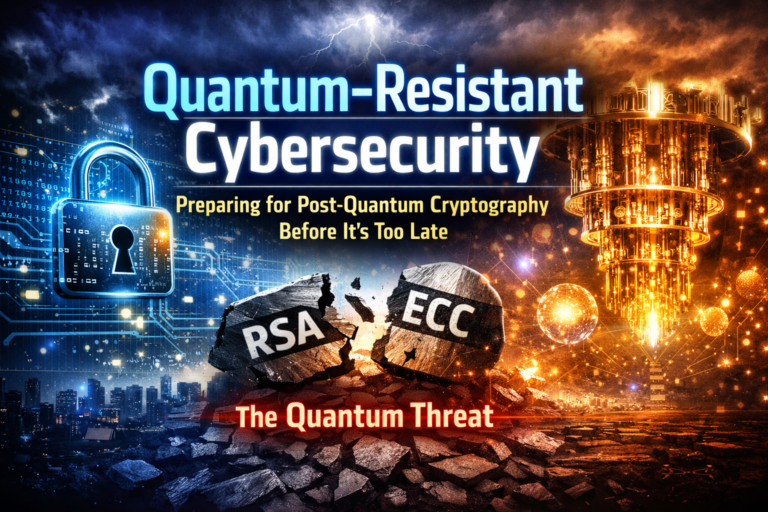
For decades, modern cybersecurity has relied on encryption standards that most people never think about. Every time you log into your bank account, send a secure email, or complete an online payment, encryption algorithms like RSA and ECC protect your data from being intercepted.
But there’s a storm quietly forming on the horizon.
Quantum computing.
While quantum computers are not yet mainstream, researchers and governments are investing billions into their development. And when quantum machines become powerful enough, they could break traditional encryption methods in minutes — methods that currently take classical computers thousands of years to crack.
This is why quantum-resistant cybersecurity and post-quantum cryptography (PQC) are rapidly becoming high-priority discussions in enterprise security strategy.
Organizations that ignore this transition risk exposing sensitive data, financial transactions, and critical infrastructure to future quantum attacks.
Let’s explore why post-quantum cryptography matters, how quantum threats work, and what businesses must do now to prepare.
Why Quantum Computing Threatens Modern Encryption
Today’s encryption systems depend on mathematical problems that are extremely difficult for classical computers to solve. RSA encryption, for example, relies on the difficulty of factoring large prime numbers.
Classical computers struggle with this task.
Quantum computers do not.
Using algorithms such as Shor’s Algorithm, a sufficiently powerful quantum computer could factor large numbers exponentially faster than classical systems. This would break widely used encryption protocols, including:
RSA (Rivest–Shamir–Adleman)
ECC (Elliptic Curve Cryptography)
Diffie-Hellman key exchange
If these cryptographic standards fail, the impact would be massive. Online banking, government communications, cryptocurrency wallets, secure cloud storage, and VPN connections would all become vulnerable.
The threat isn’t hypothetical anymore. It’s strategic.
Governments are already preparing for a “harvest now, decrypt later” scenario — where attackers collect encrypted data today and decrypt it in the future once quantum capabilities mature.
What Is Post-Quantum Cryptography (PQC)?
Post-quantum cryptography refers to cryptographic algorithms designed to resist attacks from both classical and quantum computers.
Unlike quantum encryption (which relies on quantum physics), PQC uses advanced mathematical structures that are believed to remain secure even against quantum attacks.
Common approaches include:
Lattice-based cryptography
Hash-based cryptography
Code-based cryptography
Multivariate polynomial cryptography
These algorithms are currently being standardized by organizations such as NIST (National Institute of Standards and Technology).
Here’s how traditional encryption compares with quantum-resistant alternatives:
| Feature | Traditional Encryption | Post-Quantum Cryptography |
|---|---|---|
| Resistant to classical attacks | ✔ | ✔ |
| Resistant to quantum attacks | ✖ | ✔ |
| Widely deployed today | ✔ | Limited (growing adoption) |
| Computational complexity | Moderate | Higher (in some cases) |
Transitioning to PQC isn’t optional — it’s inevitable.
High-Risk Industries Facing Quantum Threats
While quantum threats affect all sectors, some industries face particularly high exposure due to long-term data sensitivity.
1. Financial Services
Banks, fintech platforms, and payment processors rely heavily on encryption to secure transactions. If encryption fails, financial fraud risks skyrocket.
2. Healthcare and Medical Research
Patient data must remain confidential for decades. Harvest-now-decrypt-later attacks could expose long-term medical records.
3. Government and Defense
National security communications require multi-decade confidentiality. Quantum vulnerability could compromise classified intelligence.
4. Cloud Computing Providers
Cloud security providers must future-proof encryption to maintain trust and compliance.
Here’s a simplified impact overview:
| Industry | Data Longevity Risk | Quantum Vulnerability Level |
|---|---|---|
| Banking | High | Critical |
| Healthcare | Very High | Critical |
| Defense | Extremely High | Severe |
| E-commerce | Medium | High |
| SaaS Providers | High | High |
The longer the data must remain secure, the greater the quantum risk.
The “Harvest Now, Decrypt Later” Strategy
One of the most concerning quantum threats is passive data harvesting.
Attackers don’t need quantum computers today to exploit future vulnerabilities. Instead, they can:
Intercept encrypted traffic today.
Store it securely.
Wait until quantum decryption becomes feasible.
Sensitive intellectual property, trade secrets, and government communications could be exposed years from now.
This means organizations must protect data against future adversaries, not just present ones.
Cybersecurity strategy must become time-aware.
Steps Businesses Must Take Now
Transitioning to quantum-resistant cybersecurity requires proactive planning.
1. Conduct Cryptographic Inventory
Organizations should identify:
Where encryption is used
Which algorithms are implemented
How keys are generated and stored
Which systems rely on RSA or ECC
Without visibility, migration is impossible.
2. Implement Crypto Agility
Crypto agility means designing systems that can swap encryption algorithms without major infrastructure overhaul.
This allows businesses to transition smoothly when PQC standards become mandatory.
3. Follow NIST Post-Quantum Standards
NIST has begun standardizing quantum-resistant algorithms such as:
CRYSTALS-Kyber (Key Encapsulation)
CRYSTALS-Dilithium (Digital Signatures)
Adopting standardized frameworks reduces compliance risk.
4. Upgrade Cloud and Hybrid Environments
Cloud providers are beginning to offer quantum-safe encryption options. Enterprises should evaluate:
Quantum-safe VPN solutions
Secure TLS configurations
Hybrid encryption models
Quantum Cybersecurity vs Traditional Cybersecurity
To understand the scale of transformation, compare the two approaches:
| Traditional Cybersecurity | Quantum-Resistant Cybersecurity |
|---|---|
| Focused on current threats | Focused on future threats |
| Protects against classical computing attacks | Protects against quantum computing attacks |
| Static cryptographic models | Crypto-agile infrastructure |
| Short- to medium-term planning | Long-term security planning |
Quantum security forces organizations to think in decades, not quarters.
The Economic Impact of Delayed Migration
Failing to adopt quantum-resistant encryption could result in:
Regulatory penalties
Data breach lawsuits
Loss of customer trust
Intellectual property theft
Long-term reputational damage
Cyber insurance providers may also begin requiring quantum-readiness assessments.
From a financial perspective, early adoption is cheaper than emergency migration after a quantum breakthrough.
The Future of Quantum-Resistant Cybersecurity
The quantum era will not eliminate encryption — it will redefine it.
Future trends may include:
Hybrid classical + quantum encryption models
Quantum key distribution (QKD) networks
AI-driven cryptographic risk monitoring
Mandatory government compliance standards
Enterprise-wide crypto modernization programs
Organizations that invest early in quantum-safe infrastructure will gain strategic advantage.
Security maturity will soon include quantum readiness as a benchmark.
Conclusion
Quantum computing represents one of the most disruptive technological shifts of the 21st century. While it promises breakthroughs in medicine, logistics, and artificial intelligence, it also threatens the cryptographic foundations of modern cybersecurity.
Post-quantum cryptography is not science fiction. It is a necessary evolution.
Businesses that begin transitioning now — through crypto agility, algorithm upgrades, and strategic planning — will protect their digital assets against both current and future threats.
The question is no longer if quantum computing will challenge encryption.
The question is whether your organization will be ready when it does.