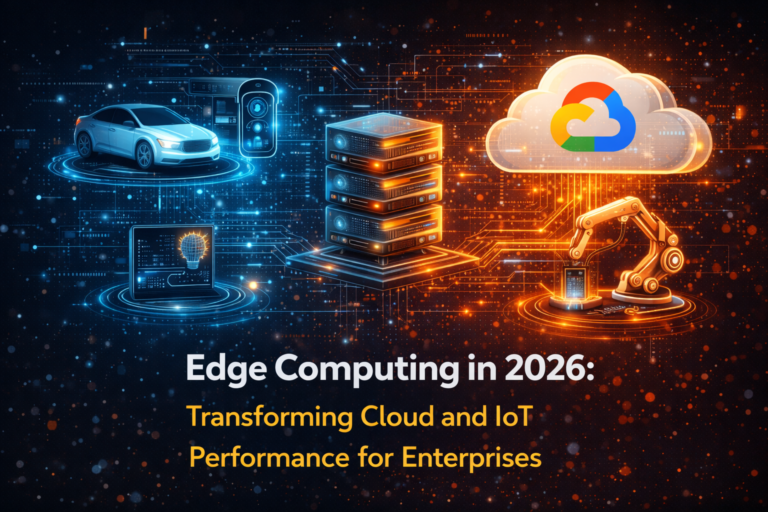
Cloud computing has dominated enterprise IT for over a decade, but the next evolution is already here: edge computing. Unlike traditional cloud architectures where all data is processed in centralized data centers, edge computing processes data closer to its source — at the network edge. This approach reduces latency, increases performance, and enables real-time decision-making for modern enterprises.
By 2026, edge computing is no longer experimental. Businesses are deploying edge strategies to support IoT devices, autonomous systems, AI workloads, and latency-sensitive applications. From smart factories to autonomous vehicles, edge computing is enabling faster insights and more responsive operations.
This article explores what edge computing is, why enterprises are adopting it, its benefits and challenges, real-world use cases, and future trends.
What Is Edge Computing?
Edge computing is the practice of processing data closer to where it is generated rather than sending it to a centralized cloud. It is particularly useful for applications that require low latency, high bandwidth, and real-time analytics.
In traditional cloud computing, devices such as sensors, smartphones, or IoT devices send data to remote servers for processing. The delay — often measured in milliseconds — can be critical in scenarios like autonomous driving or industrial automation.
Edge computing addresses this by:
Processing data locally on edge devices or micro-data centers
Reducing network congestion and latency
Enabling faster decision-making for real-time applications
Edge computing does not replace cloud computing; instead, it complements it. Centralized clouds still handle storage, heavy analytics, and archival purposes, while edge nodes handle time-sensitive tasks.
Key Benefits of Edge Computing
Enterprises adopt edge computing for multiple strategic reasons:
1. Reduced Latency
Edge computing minimizes the distance data must travel. For applications like autonomous vehicles, drone fleets, or real-time video surveillance, milliseconds matter.
2. Bandwidth Optimization
Processing data locally reduces the volume sent to centralized clouds, lowering bandwidth costs and avoiding network bottlenecks.
3. Enhanced Security and Privacy
Sensitive data can be processed locally rather than transmitted over public networks, reducing exposure to cyber threats.
4. Real-Time Analytics
Edge computing enables instantaneous insights. Industrial IoT sensors, retail checkout devices, and healthcare monitoring systems benefit from real-time alerts and predictive analytics.
5. Resilience
Even if the central cloud experiences downtime, edge nodes can continue operating independently, maintaining critical functionality.
Edge Computing Architecture
Edge computing architecture typically consists of three layers:
Device Layer: Sensors, cameras, smartphones, and IoT devices generating data.
Edge Layer: Local servers, gateways, or micro-data centers that process data near its source.
Cloud Layer: Centralized data centers that store, analyze, and aggregate data for long-term insights.
Edge vs Cloud Comparison Table
| Feature | Cloud Computing | Edge Computing |
|---|---|---|
| Latency | Higher (ms to seconds) | Very low (ms) |
| Bandwidth | High network usage | Reduced network traffic |
| Real-Time Processing | Limited | High |
| Deployment | Centralized | Distributed |
This comparison shows why latency-sensitive applications increasingly rely on edge infrastructure.
Challenges of Edge Computing
While edge computing offers clear benefits, it introduces new challenges:
1. Security Risks
Edge devices are often widely distributed and physically accessible. Protecting them from tampering, unauthorized access, and malware is critical.
2. Management Complexity
Managing thousands of edge devices across geographies can be operationally complex, especially when deploying updates, patches, or monitoring workloads.
3. Cost Considerations
Edge infrastructure requires additional investment in micro-data centers, IoT hardware, and network connectivity. Enterprises must balance performance gains against costs.
4. Data Integration
Ensuring edge-collected data is compatible and synchronized with centralized cloud systems requires robust integration and monitoring strategies.
Real-World Use Cases of Edge Computing
Edge computing is driving innovation across industries. Some examples include:
| Industry | Edge Computing Application | Benefit |
|---|---|---|
| Manufacturing | Predictive maintenance using sensor data | Reduced downtime, cost savings |
| Healthcare | Remote patient monitoring and alerts | Real-time diagnosis, improved patient outcomes |
| Retail | Smart shelves and automated checkout | Improved customer experience, inventory management |
| Transportation | Autonomous vehicles, traffic monitoring | Low-latency decision-making, safety |
| Energy | Smart grids and local energy optimization | Efficient energy distribution, reduced outages |
These use cases demonstrate edge computing’s ability to enhance performance, reliability, and responsiveness.
Best Practices for Implementing Edge Computing
Enterprises must adopt strategic practices to succeed with edge deployments:
Secure Devices and Networks: Implement strong endpoint security, encrypted communications, and continuous monitoring.
Leverage AI and Automation: Use AI at the edge to automate decisions and detect anomalies in real time.
Optimize Data Flow: Decide which data should remain at the edge and which should go to the cloud.
Standardize Management: Use centralized dashboards for monitoring, updates, and compliance.
Plan for Scalability: Design edge infrastructure to accommodate growing IoT devices and compute demand.
Future of Edge Computing in 2026 and Beyond
Edge computing is expected to grow exponentially in the next few years. Some emerging trends include:
Integration with 5G Networks: Enabling ultra-low-latency applications like AR/VR and autonomous drones.
Edge AI: Performing machine learning inference directly on devices for faster insights.
Edge-to-Cloud Orchestration: Automated data synchronization between edge and cloud.
IoT Expansion: Millions of connected devices generating vast amounts of local data.
Energy-Efficient Edge Hardware: Reducing operational costs while improving performance.
By 2026, edge computing will not just support enterprise applications — it will become a strategic differentiator in highly competitive markets.
Conclusion
Edge computing is redefining cloud strategies and enterprise IT in 2026. By processing data closer to the source, organizations gain real-time insights, reduced latency, improved security, and operational resilience.
However, successful adoption requires careful planning, robust security, centralized management, and cost optimization. Enterprises that implement edge computing effectively will enjoy faster decision-making, enhanced customer experiences, and a competitive advantage in a cloud-first world.
The future is distributed. Edge computing ensures enterprises are ready for it.
Please don’t forget to leave a review.