
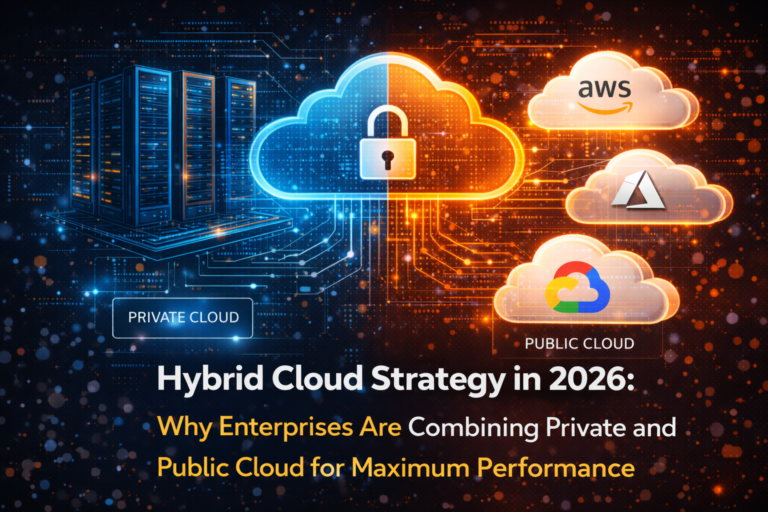
Cloud computing is no longer a one-size-fits-all solution. While many organizations initially rushed toward full public cloud adoption, reality has shown that flexibility matters more than ideology. In 2026, the dominant strategy for enterprises is neither fully public nor fully private — it’s hybrid cloud.
Hybrid cloud combines on-premise infrastructure (or private cloud environments) with public cloud services such as AWS, Microsoft Azure, or Google Cloud. This approach allows businesses to balance scalability, security, compliance, and cost efficiency without sacrificing control.
Instead of asking, “Should we move everything to the cloud?” companies are asking, “What should run where?”
That shift in thinking is driving hybrid cloud adoption across industries including healthcare, finance, retail, manufacturing, and government.
Let’s explore why hybrid cloud strategy has become mainstream, how it works, its benefits and challenges, and how organizations can implement it effectively.
What Is a Hybrid Cloud?
A hybrid cloud is an IT architecture that integrates:
Private infrastructure (on-premise servers or private cloud environments)
Public cloud services (AWS, Azure, Google Cloud)
Secure connectivity between the two environments
The goal is seamless data and workload portability between private and public systems.
Unlike multi-cloud (which uses multiple public providers), hybrid cloud specifically blends internal infrastructure with public cloud platforms.
Here’s a simplified comparison:
| Cloud Model | Description | Best For |
|---|---|---|
| Public Cloud | Fully hosted by third-party provider | Scalability, startups, global apps |
| Private Cloud | Dedicated internal infrastructure | High compliance, sensitive data |
| Hybrid Cloud | Combination of private + public | Flexibility, regulated enterprises |
Hybrid cloud enables businesses to store sensitive data privately while leveraging public cloud resources for scalability and analytics.
Why Hybrid Cloud Is Growing in 2026
Hybrid cloud adoption is accelerating because enterprises require both agility and control.
1. Regulatory Compliance
Industries like healthcare and finance must meet strict data privacy regulations (HIPAA, GDPR, PCI-DSS). Sensitive information often remains on-premise, while less sensitive workloads move to the cloud.
2. Cost Optimization
Public cloud is cost-effective for variable workloads, but predictable workloads may be cheaper to run on private infrastructure. Hybrid cloud allows strategic cost balancing.
3. Performance Requirements
Latency-sensitive applications may perform better locally, while large-scale analytics workloads benefit from cloud elasticity.
4. Business Continuity and Disaster Recovery
Hybrid environments enhance resilience. If on-premise systems fail, workloads can failover to the public cloud.
Hybrid cloud is no longer a temporary solution — it’s a strategic architecture model.
Core Components of Hybrid Cloud Architecture
A successful hybrid cloud setup requires careful integration of several components:
On-Premise Infrastructure – Local servers, storage systems, networking hardware.
Public Cloud Services – Compute, storage, databases, AI services.
Secure Connectivity – VPNs, dedicated cloud connections (e.g., AWS Direct Connect, Azure ExpressRoute).
Unified Management Platform – Monitoring, orchestration, and governance tools.
Without centralized management, hybrid environments can become fragmented and difficult to control.
Hybrid Cloud vs Public Cloud Comparison
| Feature | Public Cloud Only | Hybrid Cloud |
|---|---|---|
| Infrastructure Control | Limited | High |
| Compliance Flexibility | Moderate | Strong |
| Scalability | High | High |
| Data Sensitivity Handling | Moderate | Strong |
| Operational Complexity | Lower | Higher |
Hybrid cloud offers flexibility, but it requires strong governance and IT expertise.
Key Benefits of Hybrid Cloud Strategy
Hybrid cloud delivers multiple strategic advantages when implemented correctly.
Improved Security Posture
Sensitive data can remain within private environments, reducing exposure to external threats. At the same time, public cloud providers offer advanced security tools for non-sensitive workloads.
Workload Portability
Applications can move between environments depending on performance or cost requirements. This prevents vendor lock-in and increases agility.
Optimized Resource Utilization
Organizations can scale resources during peak demand without overinvesting in permanent infrastructure.
Enhanced Disaster Recovery
Hybrid cloud supports backup replication between on-premise and public cloud environments, strengthening business continuity planning.
Innovation Enablement
Enterprises can experiment with AI, machine learning, and analytics in the cloud while maintaining control over core systems.
Common Hybrid Cloud Use Cases
Hybrid cloud is widely used across industries:
Financial Services: Sensitive transaction data stored privately, analytics processed in public cloud.
Healthcare: Patient records kept on-premise, research data analyzed in cloud.
Retail: Inventory management local, customer analytics in cloud.
Manufacturing: Production systems on-site, predictive analytics in cloud.
Government: Secure citizen data locally, public-facing services in cloud.
These use cases demonstrate hybrid cloud’s flexibility in balancing innovation with compliance.
Security Considerations in Hybrid Cloud
While hybrid cloud improves flexibility, it increases complexity — especially in cybersecurity.
Organizations must secure:
Data moving between environments
Identity and access management (IAM) across platforms
API integrations
Network segmentation
Endpoint security
Strong encryption, Zero Trust architecture, and unified monitoring tools are essential.
Hybrid environments expand the attack surface, so centralized visibility becomes critical.
Challenges of Hybrid Cloud Deployment
Hybrid cloud is powerful but not simple.
1. Integration Complexity
Connecting legacy systems with modern cloud platforms requires technical expertise.
2. Management Overhead
IT teams must monitor and maintain both on-premise and cloud systems simultaneously.
3. Security Gaps
Misconfigured cloud services or weak connectivity protocols can expose vulnerabilities.
4. Cost Tracking Difficulties
Hybrid billing models may complicate financial planning without proper monitoring tools.
Despite these challenges, strategic planning and automation tools can mitigate most risks.
Best Practices for Hybrid Cloud Success
Enterprises should adopt structured strategies when implementing hybrid cloud:
Develop a Clear Workload Strategy – Define which workloads belong in private vs public environments.
Standardize Security Policies – Ensure consistent security controls across platforms.
Implement Centralized Monitoring – Use unified dashboards for performance and threat detection.
Automate Deployment – Use Infrastructure-as-Code (IaC) tools to streamline provisioning.
Plan for Scalability – Anticipate growth in data, users, and applications.
Hybrid cloud success depends on architecture discipline and governance.
Future Trends in Hybrid Cloud
By 2026 and beyond, hybrid cloud is evolving further:
AI-Driven Workload Placement – Automatically deciding optimal environments for performance and cost.
Edge + Hybrid Integration – Combining edge computing with hybrid cloud strategies.
Improved Interoperability Standards – Simplifying cross-platform communication.
Zero Trust by Default – Enhanced identity-based security frameworks.
Sustainability Optimization – Energy-efficient workload distribution.
Hybrid cloud is becoming the default enterprise architecture model.
Conclusion
Hybrid cloud strategy in 2026 reflects a mature approach to cloud computing. Enterprises no longer chase trends blindly. Instead, they combine private and public infrastructure to optimize performance, ensure compliance, and maintain operational resilience.
By balancing scalability with control, hybrid cloud empowers businesses to innovate without compromising security or governance.
The future of cloud computing isn’t about choosing one model over another.
It’s about integrating them intelligently.
Please don’t forget to leave a review.