
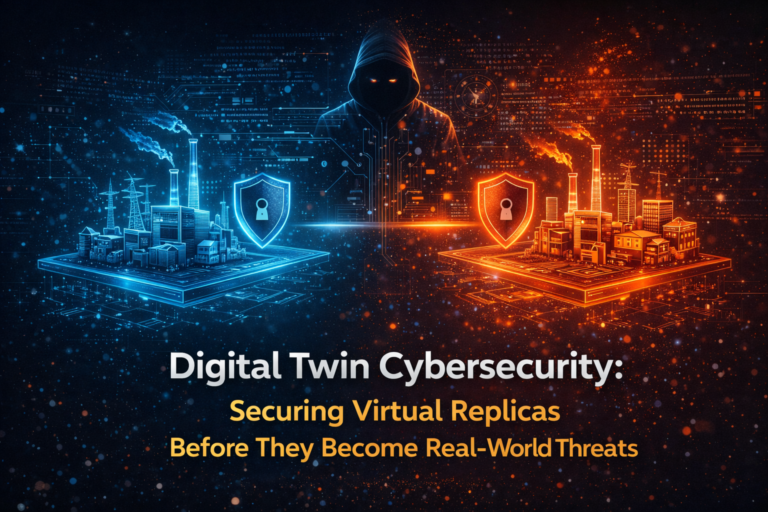
Cybersecurity conversations usually revolve around cloud security, ransomware protection, or endpoint defense. But there’s a new frontier emerging quietly — and it’s far more complex than most organizations realize.
It’s called Digital Twin Cybersecurity.
Digital twins are virtual replicas of physical systems. They mirror real-world environments such as manufacturing plants, smart cities, power grids, hospitals, supply chains, and even entire enterprise networks. These virtual models simulate performance, detect inefficiencies, and predict failures before they happen.
Sounds innovative? It is.
But here’s the problem: if attackers compromise a digital twin, they don’t just access data — they gain insight into how real-world systems operate. And in some cases, they can manipulate outcomes before changes are deployed physically.
In 2026, as industries adopt digital twins for predictive maintenance, AI optimization, and operational modeling, securing these virtual environments is becoming mission-critical.
Let’s explore why digital twin cybersecurity matters — and how organizations can defend this emerging attack surface.
What Is a Digital Twin — and Why Is It a Cybersecurity Risk?
A digital twin is a real-time virtual model of a physical asset, system, or process. It collects data from sensors, IoT devices, cloud platforms, and operational systems to simulate behavior.
For example:
A manufacturing plant uses a digital twin to simulate production efficiency.
A smart grid mirrors electricity flow to predict outages.
A logistics company models global shipping routes in real time.
A hospital replicates patient flow systems to improve resource allocation.
The twin is continuously updated with live data. That’s what makes it powerful.
But it’s also what makes it vulnerable.
If attackers infiltrate the digital twin, they can:
Study infrastructure weaknesses
Manipulate predictive outputs
Inject false data
Influence decision-making systems
Disrupt physical operations indirectly
Digital twins bridge cyber and physical systems. That bridge must be protected.
Why Digital Twins Create a New Attack Surface
Unlike traditional IT systems, digital twins combine:
Operational Technology (OT)
Information Technology (IT)
IoT device networks
Cloud infrastructure
AI-driven analytics engines
This convergence expands the attack surface significantly.
Here’s how digital twin environments differ from traditional systems:
| Traditional IT System | Digital Twin Ecosystem |
|---|---|
| Primarily data storage | Real-time operational modeling |
| Limited physical impact | Direct physical-world implications |
| Isolated enterprise network | Hybrid IT/OT integration |
| Static configurations | Continuous real-time updates |
Because digital twins simulate physical processes, compromising them can influence decisions affecting real machinery, utilities, or healthcare systems.
An attacker doesn’t need to sabotage equipment directly. They only need to manipulate the model that guides operational decisions.
That’s a strategic vulnerability.
Digital Twin Threat Scenarios: How Attacks Could Unfold
To understand the risk, consider practical threat scenarios.
1. Predictive Manipulation Attack
A manufacturing company relies on its digital twin to predict equipment failure. An attacker injects false sensor data, making the system believe certain machines are healthy when they are not.
Result:
Maintenance schedules are delayed.
Equipment fails unexpectedly.
Production halts.
Financial losses escalate.
The attack never touched the physical machine — only the virtual model.
2. Smart Grid Disruption
A power grid operator uses a digital twin to balance load distribution. If attackers alter simulation outputs, they could trigger miscalculations in energy distribution.
Possible consequences include:
Artificial load imbalance
Grid instability
Widespread outages
Cascading infrastructure failures
Critical infrastructure becomes vulnerable through model manipulation.
3. Industrial Espionage via Twin Replication
If attackers gain access to a digital twin of a proprietary manufacturing process, they essentially obtain a blueprint of operational intelligence.
This could expose:
Trade secrets
Optimization strategies
Production algorithms
Supply chain logic
The digital twin becomes an intellectual property goldmine.
Core Security Challenges in Digital Twin Environments
Digital twin cybersecurity presents unique challenges due to its hybrid nature.
1. IT and OT Convergence Risks
Operational technology systems were not originally designed for internet connectivity. Integrating them with cloud-based twins increases exposure.
2. Real-Time Data Integrity
Because digital twins depend on live sensor feeds, even minor data manipulation can alter outcomes significantly.
3. AI Model Manipulation
Many digital twins rely on AI-driven simulations. Model poisoning or algorithm tampering can distort predictive analytics.
4. Expanded IoT Attack Surface
Thousands of connected devices feed data into digital twins. Each device represents a potential entry point.
These complexities require layered defense strategies.
Digital Twin Security Framework: A Multi-Layered Approach
Protecting digital twins requires a holistic cybersecurity architecture.
1. Zero Trust Architecture for Twin Access
Every user, device, and application interacting with the digital twin should undergo continuous authentication.
Key components include:
Multi-factor authentication
Role-based access controls
Micro-segmentation of OT networks
Continuous identity verification
Zero Trust ensures no implicit trust exists between physical systems and digital replicas.
2. Real-Time Data Validation and Integrity Monitoring
Since digital twins rely on live data streams, validating input data is critical.
Security teams should implement:
Anomaly detection algorithms
Sensor data validation rules
Cryptographic data signing
Continuous monitoring dashboards
If incoming data deviates from expected behavioral patterns, alerts should trigger immediately.
3. Secure API Architecture
Digital twins often integrate through APIs with enterprise systems and cloud platforms.
API security best practices include:
OAuth-based authentication
Encrypted communication (TLS 1.3)
Rate limiting and throttling
Continuous API traffic monitoring
APIs are common attack vectors in complex ecosystems.
4. AI Model Protection
If AI drives the twin’s predictive engine, the model itself must be secured.
Protection strategies:
Controlled training environments
Dataset validation pipelines
Adversarial testing
Strict access governance for model updates
Compromised AI models lead to compromised outcomes.
Digital Twin Security Risk Comparison
| Threat Category | Potential Impact | Detection Difficulty | Mitigation Priority |
|---|---|---|---|
| Data Manipulation | Operational disruption | High | Critical |
| AI Model Poisoning | Faulty predictions | Medium | High |
| IoT Device Compromise | Entry point for lateral movement | Medium | High |
| API Exploitation | Unauthorized data access | High | Critical |
| Insider Threat | Strategic sabotage | High | Critical |
This risk matrix shows that digital twin ecosystems require enterprise-grade security maturity.
Regulatory and Compliance Considerations
Industries using digital twins — such as energy, healthcare, aerospace, and manufacturing — often operate under strict compliance frameworks.
Organizations must ensure:
Data encryption standards are met
Audit trails are maintained
Access logs are immutable
Incident response protocols are documented
Third-party integrations undergo security assessment
As digital twins become common in critical infrastructure, regulators are likely to introduce specific security mandates.
Proactive compliance planning is essential.
The Future of Digital Twin Cybersecurity
Digital twins will expand beyond factories and grids. Smart cities, autonomous transportation systems, defense infrastructure, and healthcare ecosystems are increasingly adopting virtual replication models.
With that expansion comes greater risk.
Future security innovations may include:
AI-driven self-healing twin systems
Blockchain-based data validation for sensor feeds
Secure-by-design IoT frameworks
Digital twin threat intelligence platforms
The cybersecurity industry must evolve alongside this technological shift.
Conclusion
Digital twin technology represents a powerful innovation in operational efficiency, predictive modeling, and real-time optimization.
But with innovation comes exposure.
By merging physical systems with virtual intelligence, digital twins create a new cybersecurity frontier — one where data manipulation can influence real-world outcomes.
Organizations that adopt digital twin technology must treat cybersecurity as foundational, not optional. Zero Trust architecture, AI model protection, API security, and data integrity validation must become core components of digital twin deployment strategies.
The future of cybersecurity isn’t just about protecting data.
It’s about protecting reality itself.
Please don’t forget to leave a review.
Pingback: AI Model Poisoning Attacks: The Invisible Cybersecurity Threat Targeting Machine Learning Systems - TECHZ