
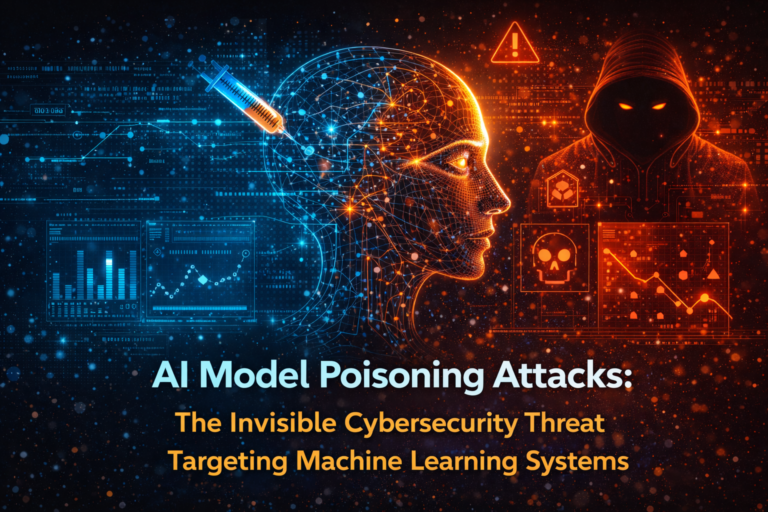
Cybersecurity is no longer just about firewalls, phishing emails, or ransomware. In 2026, one of the most dangerous and least understood threats is happening quietly inside artificial intelligence systems.
It’s called AI model poisoning.
As organizations integrate machine learning into fraud detection, healthcare diagnostics, financial trading, cybersecurity defense, and autonomous systems, attackers are shifting their focus. Instead of breaking into networks directly, they are targeting the intelligence layer itself.
If attackers can corrupt the training data or manipulate the learning process of an AI model, they don’t need to hack the system afterward. The system becomes compromised by design.
And that’s what makes model poisoning so dangerous.
Let’s explore how AI model poisoning works, why it’s growing rapidly, and how organizations can defend against this emerging cybersecurity threat.
What Is AI Model Poisoning?
AI model poisoning is a cyberattack where malicious actors intentionally inject corrupted, manipulated, or misleading data into the training dataset of a machine learning system.
Machine learning models learn patterns from data. If the data is flawed, the learned behavior becomes flawed.
For example:
A fraud detection system trained with manipulated transaction data may fail to detect real fraud.
A facial recognition system exposed to biased training samples may misidentify certain individuals.
A malware detection engine poisoned with crafted samples may allow malicious software to bypass detection.
Unlike traditional cyberattacks that exploit system vulnerabilities, model poisoning attacks the learning process itself.
This makes detection extremely difficult because the AI system appears to function normally — until it fails at a critical moment.
Why AI Model Poisoning Is Increasing in 2026
The rise of AI adoption has expanded the attack surface dramatically. Machine learning is now embedded in:
Financial services
Healthcare analytics
Autonomous vehicles
Cloud security systems
Smart city infrastructure
Military and defense technologies
The more critical the AI system, the more attractive it becomes as a target.
Here’s why model poisoning attacks are increasing:
| Factor | Impact on Risk |
|---|---|
| Open-source datasets | Easier to inject malicious samples |
| Crowdsourced training data | Reduced quality control |
| Continuous model retraining | Persistent exposure to new data |
| Automated AI pipelines | Faster deployment with less oversight |
| High-value AI decision systems | Greater incentive for attackers |
Organizations are racing to deploy AI-driven analytics and automation, sometimes prioritizing speed over security. Attackers are exploiting that gap.
Types of AI Model Poisoning Attacks
AI model poisoning is not a single technique. It includes multiple attack strategies depending on the attacker’s goal.
1. Targeted Poisoning
The attacker aims to manipulate the model’s behavior for specific inputs. For example, ensuring that a particular malicious file is always classified as safe.
This is particularly dangerous in cybersecurity systems.
2. Availability Attacks
The goal is to degrade overall model performance. By injecting noisy or misleading data, attackers reduce prediction accuracy and create operational disruption.
3. Backdoor Attacks
Attackers insert hidden triggers into the model. When a specific pattern appears, the AI behaves incorrectly — even if performance appears normal otherwise.
For example, a small pixel pattern in an image could cause misclassification in a vision system.
Real-World Impact of Model Poisoning
AI model poisoning has serious real-world consequences.
Imagine a bank relying on machine learning for credit risk assessment. If attackers manipulate training data, the model might approve high-risk loans or reject legitimate customers.
In healthcare, poisoned diagnostic AI systems could produce inaccurate medical recommendations.
In cybersecurity, a compromised malware detection model could allow ransomware to pass undetected.
Here’s a simplified impact comparison:
| Sector | Potential Consequence |
|---|---|
| Finance | Fraud approval, credit risk errors |
| Healthcare | Incorrect diagnoses |
| Cybersecurity | Undetected malware |
| Autonomous Vehicles | Faulty object detection |
| Defense | Misinterpreted threat signals |
The danger isn’t just data loss — it’s decision corruption.
How Model Poisoning Bypasses Traditional Security
Traditional cybersecurity tools focus on:
Network intrusion detection
Endpoint protection
Firewall monitoring
Access control systems
Model poisoning operates at a deeper layer — inside the algorithm itself.
Because the AI system continues running without crashing, organizations may not detect manipulation until damage occurs.
Additionally, AI systems often retrain automatically using fresh data streams. If those streams are compromised, the poisoning becomes continuous.
This makes machine learning pipelines a new cybersecurity frontier.
Defending Against AI Model Poisoning Attacks
Protecting AI systems requires specialized strategies that combine cybersecurity and data science.
1. Secure Data Pipelines
Organizations must validate training data sources carefully. Data integrity verification mechanisms should ensure that input data hasn’t been tampered with.
Key practices include:
Data source authentication
Encryption of data transfers
Strict dataset version control
Controlled data ingestion processes
2. Anomaly Detection in Training Data
Statistical analysis tools can detect unusual patterns in datasets before models are trained.
If certain samples significantly deviate from expected distributions, they should be flagged for review.
AI can be used to defend AI.
3. Model Validation and Testing
Before deployment, models should undergo adversarial testing. Security teams can simulate poisoning attempts to measure resilience.
This process is similar to penetration testing but applied to machine learning systems.
4. Access Control for AI Development Environments
Only authorized personnel should have access to:
Training datasets
Model weights
Configuration files
AI deployment pipelines
Zero Trust architecture should extend to machine learning infrastructure.
AI Model Poisoning vs Traditional Data Breaches
To understand the severity, consider this comparison:
| Traditional Data Breach | AI Model Poisoning |
|---|---|
| Steals sensitive data | Corrupts decision systems |
| Immediate detection possible | Often silent and hidden |
| One-time compromise | Long-term behavioral impact |
| Data exposure risk | Strategic operational risk |
While data breaches expose information, model poisoning reshapes how systems behave.
In many cases, the damage is more subtle — but more dangerous.
The Future of AI Security and Model Integrity
As artificial intelligence becomes foundational to business intelligence, fraud detection, autonomous operations, and cybersecurity itself, protecting AI models will become as important as protecting networks.
Future security trends may include:
Blockchain-based dataset validation
Federated learning security frameworks
AI model watermarking
Continuous model integrity monitoring systems
Government regulations for AI risk governance
The cybersecurity industry is beginning to recognize AI model security as a dedicated discipline — sometimes referred to as MLSecOps (Machine Learning Security Operations).
Organizations that fail to secure their AI systems may find themselves vulnerable in ways traditional security tools cannot detect.
Conclusion
AI model poisoning attacks represent a silent but powerful cybersecurity threat in 2026.
By targeting the training data and learning mechanisms of machine learning systems, attackers can manipulate outcomes, bypass defenses, and disrupt critical infrastructure without triggering traditional alarms.
As AI becomes central to business strategy, cybersecurity must evolve to protect not just networks and data — but intelligence itself.
Securing AI is no longer optional.
It is the next frontier of cybersecurity.


Pingback: Cloud Workload Protection Platforms (CWPP): The Enterprise Cybersecurity Strategy Securing Modern Cloud Infrastructure - TECHZ
Pingback: Extended Detection and Response (XDR): The Next Evolution of Enterprise Cybersecurity in 2026 - TECHZ